

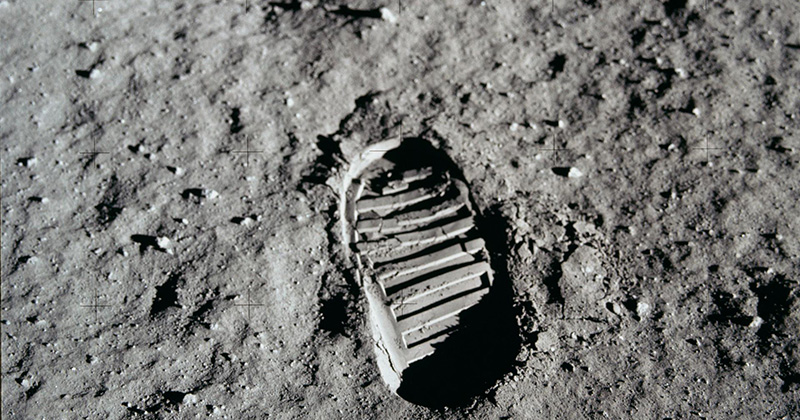
UD researchers are developing materials to build infrastructure on the moon and beyond
Building material samples from the University of Delaware spent six months mounted outside of the International Space Station, where the harsh conditions of low Earth orbit tested their limits. Some returned with higher measured strength than identical samples stored on Earth.
The findings are a promising sign for the long-term goal of building infrastructure on the moon. There are no lunar supply yards, and transporting building materials from Earth would be prohibitively expensive. The solution may lie underfoot, in the form of lunar dust known as regolith.
“Regolith is essentially a clay-like silicate material,” said Norman Wagner, Unidel Robert L. Pigford Chair in Chemical Engineering. “It is one of the most abundant materials on both Earth and the moon, which makes it interesting for construction.”
Wagner’s laboratory develops geopolymers, a cement alternative that binds clays into a strong solid through chemical reactions rather than high-temperature manufacturing. Their goal is to use regolith with minimal additives to produce construction materials without energy-intensive processing. The approach could contribute to more sustainable Earth-based construction, too.
To evaluate how geopolymers hold up in space, the UD team sent thin plates made from commercially available simulated lunar and Martian regolith to the International Space Station as part of NASA’s MISSE-20 mission.
“You cannot fully understand how materials behave in space until you actually test them in space,” said Wagner. “It is a hostile environment. Temperature swings, radiation and micrometeorite impacts all matter.”
The thin plates were mounted outside the space station and exposed to low-Earth-orbit conditions for about half a year, then compared with identical samples stored on Earth. The findings, published in Advances in Space Research, showed the geopolymers did not deteriorate, and in some cases were stronger after their time in orbit.
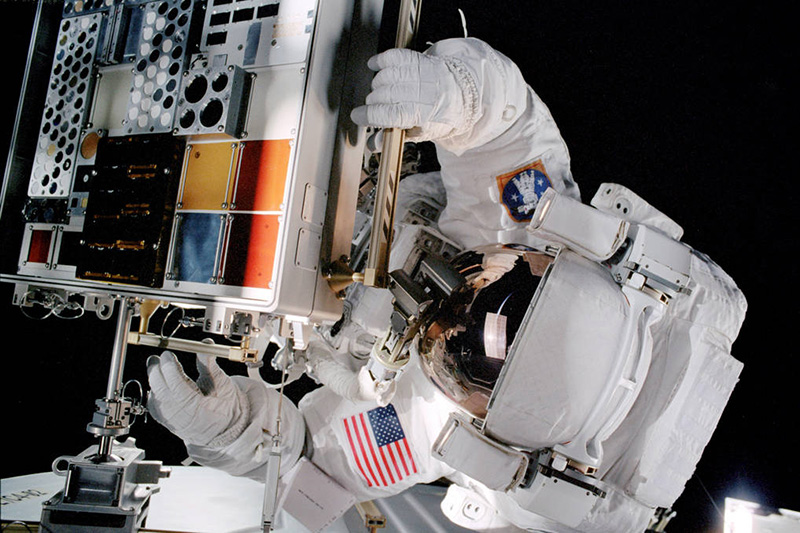
Astronaut working with the Materials International Space Station Experiment (MISSE). Credit: NASA/MSFC
Lunar construction materials must not only survive space conditions, they also must be reliably manufactured on-site. In a separate study in Acta Astronautica, Wagner’s team used artificial intelligence to tackle a practical challenge: not all lunar clays are the same. The researchers developed a machine learning model that can predict how strong a geopolymer will be based on the characteristics of the starting regolith and how it is processed.
Trained on a combination of new experimental results and data from 30 previous studies, the model can help identify promising recipes without physically testing every possibility. This approach could accelerate efforts to build with local lunar resources while reducing the amount of material that must be transported from Earth.
Complementary work from the Wagner lab offers insight into how geopolymers behave while being mixed, pumped and shaped before they harden. The researchers identified a key transition point, known as the critical gel point, at which the material shifts from a workable slurry into a solidifying structure. Mixing or shearing before that point did not affect how long the material took to harden or its final strength. This suggests that engineers may have flexibility in how they handle and process lunar construction materials, without compromising quality.
That work appears in a special issue of the Journal of Rheology focused on materials behavior beyond Earth. Wagner guest-edited the issue with collaborators Olfa D’Angelo of the University of Amsterdam and Thomas Voigtmann of the German Aerospace Center.
In the opening editorial, the guest editors note that low-gravity and space research are not solely about enabling exploration. They also provide new tools and perspectives to improve life on Earth.
In the case of geopolymers, the same characteristics that make them attractive for lunar construction—reliance on abundant raw materials and less energy-intensive production than conventional cement—could help reduce the carbon footprint of terrestrial infrastructure.
In that sense, solving the challenge of how to build on the moon may also help engineers rethink how we build at home.
Article by Hillary Hoffman